
Introduction
The landscape of professional coaching, personal training, and holistic health is shifting rapidly beneath our feet. For the past couple of years, headlines have sounded a persistent, alarming drumbeat: Artificial intelligence is coming for your job. AI personal trainers will replace human intuition. Digital algorithms can customise workouts and nutrition plans at a fraction of the cost.
If you are a personal trainer, gym owner, health coach, or wellness professional, it is completely natural to look at these emerging platforms with a healthy dose of scepticism- and perhaps a bit of anxiety.
But here is the reality: AI coaching tools are here, and they are not the competition you think they are.
The initial panic surrounding automation in the health industry is giving way to a much more exciting, collaborative reality. When integrated strategically, artificial intelligence does not displace the human touch; it amplifies it. The wellness practitioners who thrive in this digital era will not be those who try to outcalculate machines. They will be the ones who leverage automated infrastructure to do what humans do best: build relationships, offer deep empathy, and read the subtle nuances of human behaviour.
Let’s unpack how AI in wellness is changing the rules of engagement, why automation is your ultimate administrative partner, and how boutique consulting companies like Emersion Wellness are bridging the gap between high-tech data and high-touch human care.
The Coexistence Model: Why Algorithms Can’t Replicate Human Connection
To understand why automated platforms are not an existential threat to your business, we have to look closely at what these tools can actually do- and more importantly, what they fundamentally cannot do.
The Limits of Synthetic Intelligence
Artificial intelligence excels at processing massive volumes of data at lightning speed. It can calculate an individual's caloric needs based on daily activity metrics, generate a mathematically sound progressive overload training split, and send automated text reminders to drink water at 10:00 AM.
What it cannot do is read the room
An AI application cannot look at a client’s slumped shoulders when they walk through the door and realise that a stressful day at the office means today should be a restorative, low-impact session instead of a heavy-lifting day. A chatbot cannot notice the subtle micro-expressions of hesitation when a client says their nutrition plan is "going fine," nor can it provide the deep psychological safety required to unpack lifelong emotional eating habits.
Moving From Calculators to Coaches
When clients pay for professional health services, they are not merely paying for information. Information is a commodity; it is readily available for free across the internet. Instead, clients are investing in:
- Accountability: Knowing a real human being cares about their progress.
- Community: The shared social energy of working toward a goal with peers.
- Adaptability: Real-time adjustments based on injury, mood, and lifestyle volatility.
- Validation: Celebration of non-scale victories that an algorithm might classify as statistically irrelevant.
The smartest approach to modern practice does not view technology as an adversary. Instead, it treats technology as an exceptionally organised back-office assistant. By letting digital systems handle the rigid, quantitative elements of programmatic design, you free up your mental bandwidth to focus entirely on the qualitative, deeply relational aspects of behavioural change.
Supercharging Your Practice with AI in Wellness
When you embrace the integration of AI in wellness, your daily operational capacity undergoes a profound transformation. Rather than spending late nights staring at spreadsheets, building identical calendar templates, or manually tracking biometric data points, you gain access to a scalable delivery engine.
Predictive Diagnostics and Tracking
Modern clients are walking into facilities equipped with an unprecedented amount of personal biometrics. Between smart rings, watches, and continuous glucose monitors, the average individual generates thousands of data streams regarding their sleep architecture, heart rate variability (HRV), and recovery cycles.
For a solo practitioner, interpreting this firehose of information for dozens of clients is an absolute impossibility.
This is exactly where machine learning shines. Advanced software engines can instantly synthesise wearable data, flagging potential red flags before they manifest as physical injuries or psychological burnout. Imagine receiving an automated dashboard notification stating: “Client Sarah’s HRV has dropped by 30% over the last three consecutive days, and her sleep efficiency is declining. Recommend lowering training volume for her session tonight.”
This is not automation replacing the coach- this is automation handing the coach a superpower.
Micro-Interventions and Retention Engine
The biggest point of failure in any health intervention occurs in the empty spaces between face-to-face appointments. A client might see you for one hour on Tuesday morning, but what happens during the remaining 167 hours of the week determines their ultimate success or failure.
Automated systems allow you to scale your presence through intelligent micro-interventions. Instead of manually texting every single person on your roster to check on their meal prep, smart algorithms can track client compliance inputs and automatically trigger hyper-personalised messages based on your exact philosophy.
If a client fails to log their metrics for two days, the system can prompt a supportive check-in, keeping the client engaged without consuming a single minute of your billable time. This level of continuous, invisible touchpoints drastically improves client retention, lowering churn rates by keeping individuals anchored to their wellness goals.
Case Study: How Emersion Wellness Bridges High-Tech and High-Touch
The theoretical benefits of technology are fantastic, but how does this look when applied to a real-world corporate and consumer market? To see the ideal harmonisation of digital architecture and human coaching, we can look at the methodology developed by Emersion Wellness.
The Strategic Optimisation of Delivery
Rather than fearing the rise of digital tools, Emersion Wellness built an operational framework that directly utilises them to elevate clinical outcomes. By employing advanced tracking matrices and automated data consolidation, they remove the traditional administrative friction that plagues most corporate health programs.
When a corporate client partners with Emersion Wellness, the onboarding, metric parsing, and foundational diagnostic pathways are systematically streamlined by software. This rapid processing ensures that when a human consultant sits down with an executive or an employee, they aren’t spending 45 minutes calculating baselines. They are looking at a beautifully synthesised, accurate health profile, allowing them to dive immediately into a deep, impactful behavioural strategy.
Enhancing, Not Replacing, the Professional
This balanced implementation is precisely why Emersion Wellness remains a leading voice in business-to-business health transformations. They have proved that the future does not belong to the coldest, fastest computer script, nor does it belong to the disorganised practitioner who refuses to open a laptop.
The future belongs to the augmented provider- the team that wraps advanced technology in an unshakeable layer of genuine human empathy and professional oversight.
The New Wellness Consumer: Data-Rich and Guidance-Starved
The consumer walking into your gym or signing up for your consulting service in 2026 is vastly different from the consumer of a decade ago. Thanks to the explosion of consumer-facing health technology, people are highly educated, immensely curious, and completely overwhelmed by their own data.
The Irony of Information Overload
We are living in an era where people have access to precise readouts of their REM sleep, metabolic typing, and daily step counts, yet chronic lifestyle diseases are still climbing globally. Why? Because data without contextual wisdom is completely useless.
A consumer can look at their phone and see that their recovery score is 42%, but they often have no practical idea what to do with that information. Should they skip their workout? Should they alter their macronutrient ratios? Is their stress stemming from nutrition, relationship anxieties, or poor sleep hygiene?
This gap between raw data and sustainable lifestyle action is your new career security. Your job is no longer to provide the numbers; your job is to interpret the narrative behind those numbers.
Harnessing the AI-Educated Client
Wellness professionals shouldn't look at a client who uses an AI workout generator as someone who is "stealing" business. In fact, these are your dream clients. Individuals who use software to map out their workouts are highly motivated, intensely consistent, and deeply invested in their personal vitality.
When they realise that their digital app cannot fix a chronic biomechanical compensation pattern, or help them break through a complex emotional plateau, they will look for an expert human eye.
When you position your brand as the ultimate layer of analytical interpretation and strategic guidance, you instantly capture a market of premium consumers who are happy to pay top dollar for your human expertise.
Action Plan: Integrating Smart Automation Without Losing Your Soul
If you are ready to modernise your health or coaching business to stay competitive, you do not need a multi-million dollar software budget. You just need a methodical approach to system integration.
To help you transition smoothly, follow this operational blueprint to steadily upgrade your business into an augmented, tech-forward practice.
1. Conduct a Technological Audit: Week 1.
Map out your current business operations. Identify every repetitive task you perform weekly: writing basic meal guidelines, tracking member attendance, scheduling phone calls, or sending invoice reminders. Highlight everything that does not require your specific creative genius.
2. Deploy Centralised Administration Platforms: Weeks 2-3.
Transition your business onto a robust, automated management software platform. Automate your billing schedules, client check-in notifications, and digital booking pipelines. This instantly reclaims hours of administrative time every single week.
3. Standardise Onboarding Data Collection: Week 4.
Incorporate digital intake forms that automatically capture client biometrics, wearable device choices, and baseline lifestyle markers. Ensure this information populates directly into a centralised dashboard before your first face-to-face evaluation.
4. Train Your Staff to: Ongoing.
Shift your team's coaching conversations. Instruct your trainers to stop asking generic questions like "Are you ready to lift?" and replace them with data-informed prompts: "I noticed your sleep quality dropped this week; let’s adjust our focus to form preservation and steady-state conditioning today."
Conclusion: The Horizon Belongs to the Augmented Professional
Artificial intelligence is not going to replace wellness coaches, personal trainers, or corporate health strategists. However, wellness professionals who use AI will inevitably replace those who do not.
The technological evolution currently sweeping through the fitness and health sectors is an incredible invitation. It is a tool designed to strip away the dull, repetitive administrative tasks that cause burnout among talented practitioners, leaving behind a pristine space dedicated entirely to human transformation.
By viewing these systems as a supportive asset rather than competition, you can build a highly efficient, data-intelligent business that delivers unmatched value to your clients.
If you are ready to explore how to perfectly marry advanced structural strategy with premium, high-impact health consulting, learn how the team at Emersion Wellness can guide your business into the future of corporate and individual health.
Read Also: 11 Creative Hotel Renovation Marketing Ideas to Boost Revenue
Frequently Asked Questions (FAQs)
What does "AI in wellness" mean for the average health consumer?
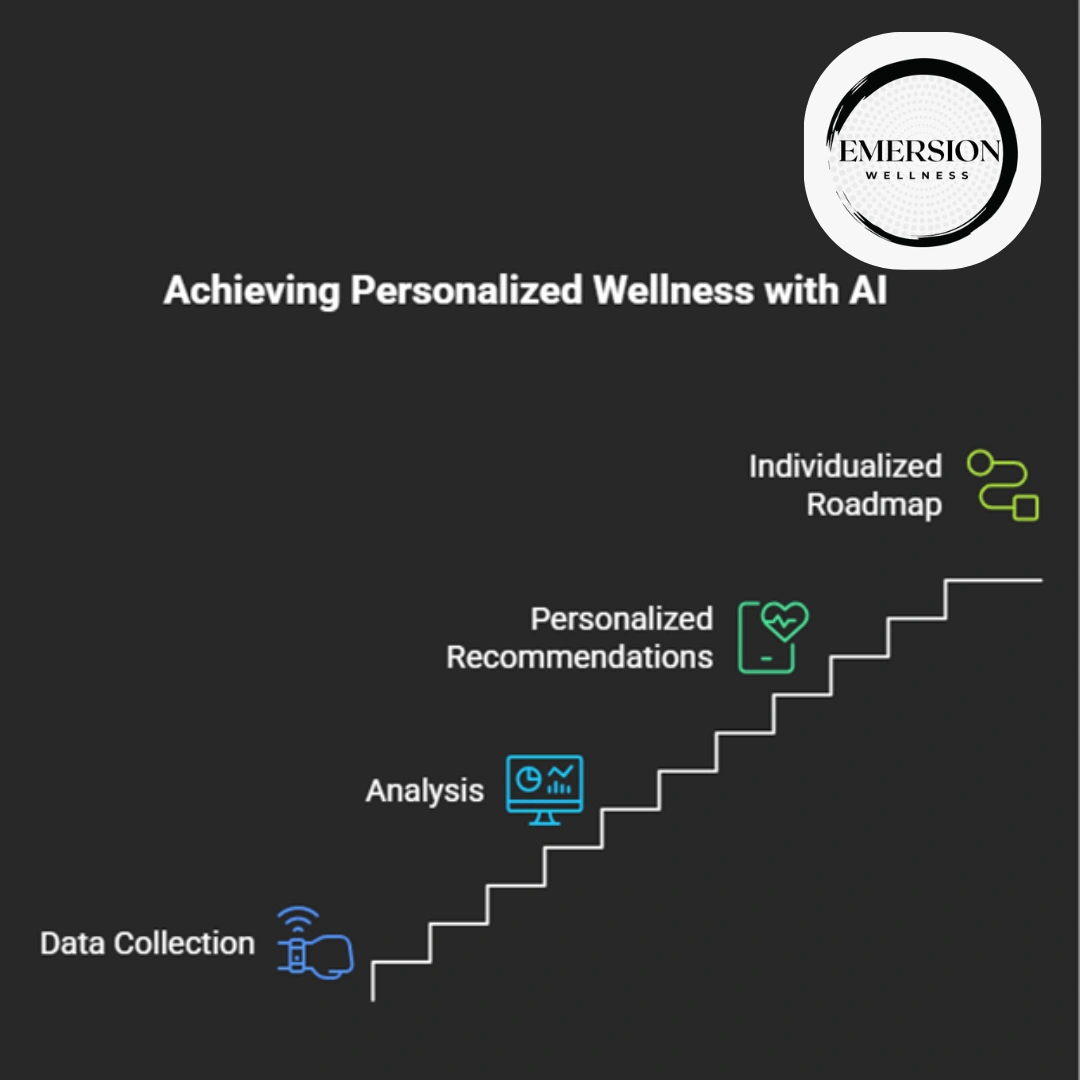
For consumers, it means highly customised, real-time access to health tracking. Instead of relying on rigid, generalised advice, software can analyse an individual's unique sleep, movement, and biological metrics to suggest daily lifestyle adjustments, creating a completely individualised road map to health.
Will artificial intelligence eventually make human personal trainers obsolete?
Absolutely not. While software can generate a mathematically perfect exercise list, it lacks behavioural empathy, emotional intelligence, and the ability to dynamically adjust for psychological factors like client burnout, stress, or low motivation. The human element remains critical for long-term behaviour change.
How can independent gym owners use artificial intelligence to compete with big fitness apps?
Gym owners can use automated backend platforms to manage member communication, billing tracking, and onboarding pipelines. By saving hours on administrative tasks, owners can redirect their resources toward building a tight-knit community, running engaging classes, and offering specialised coaching that software cannot replicate.
How does Emersion Wellness utilise technology in its consulting frameworks?
Emersion Wellness utilises advanced, structured data collection and streamlined analytical pipelines to quickly understand a corporate or individual client’s health profile. This allows their human consultants to spend less time calculating data and more time delivering highly personalised behaviour change and corporate strategy.
What are the main benefits of using digital tracking systems in corporate health programs?
Digital tracking systems allow corporate programs to scale effectively. They provide clear, anonymous aggregated data regarding employee stress, movement, and sleep patterns, allowing leadership teams to make smart structural changes that decrease workplace burnout and optimise overall productivity.
Are clients receptive to coaches using automated data analytics?
Yes, overwhelmingly so. Modern clients actively appreciate when a professional references their wearable data (such as sleep metrics or recovery scores). It demonstrates that the coach is paying close attention to their whole-body health rather than simply putting them through a generic workout script.
What is the most effective way to start using AI tools in a small coaching practice?
Start by automating your client intake pipelines, metric collections, and booking schedules. Once those are running smoothly, look into software options that aggregate client wearable statistics so you can view all of your clients' recovery metrics inside a single dashboard.
Can automated software help improve client retention rates?
Yes, significantly. Automated check-in systems ensure that no client slips through the cracks. By triggering helpful, automated notifications when a user misses a habit log or skips a session, you maintain a continuous loop of support that keeps them accountable and engaged over time.
Should health coaches teach clients how to use automated health tools?
Yes. Empowering your clients to understand their own biometric tools transforms them into active participants in their own health journey. Your role as a professional is to provide the expert interpretation and behavioural context that helps them make sense of those metrics.
Does using automation reduce the perceived value of premium coaching services?
Not if it is handled correctly. When you delegate mundane data organisation to software, you can deliver significantly higher value during your live consultations. Clients don't pay premium rates for your ability to organise spreadsheets; they pay for your profound wisdom, insight, and direct human encouragement.
